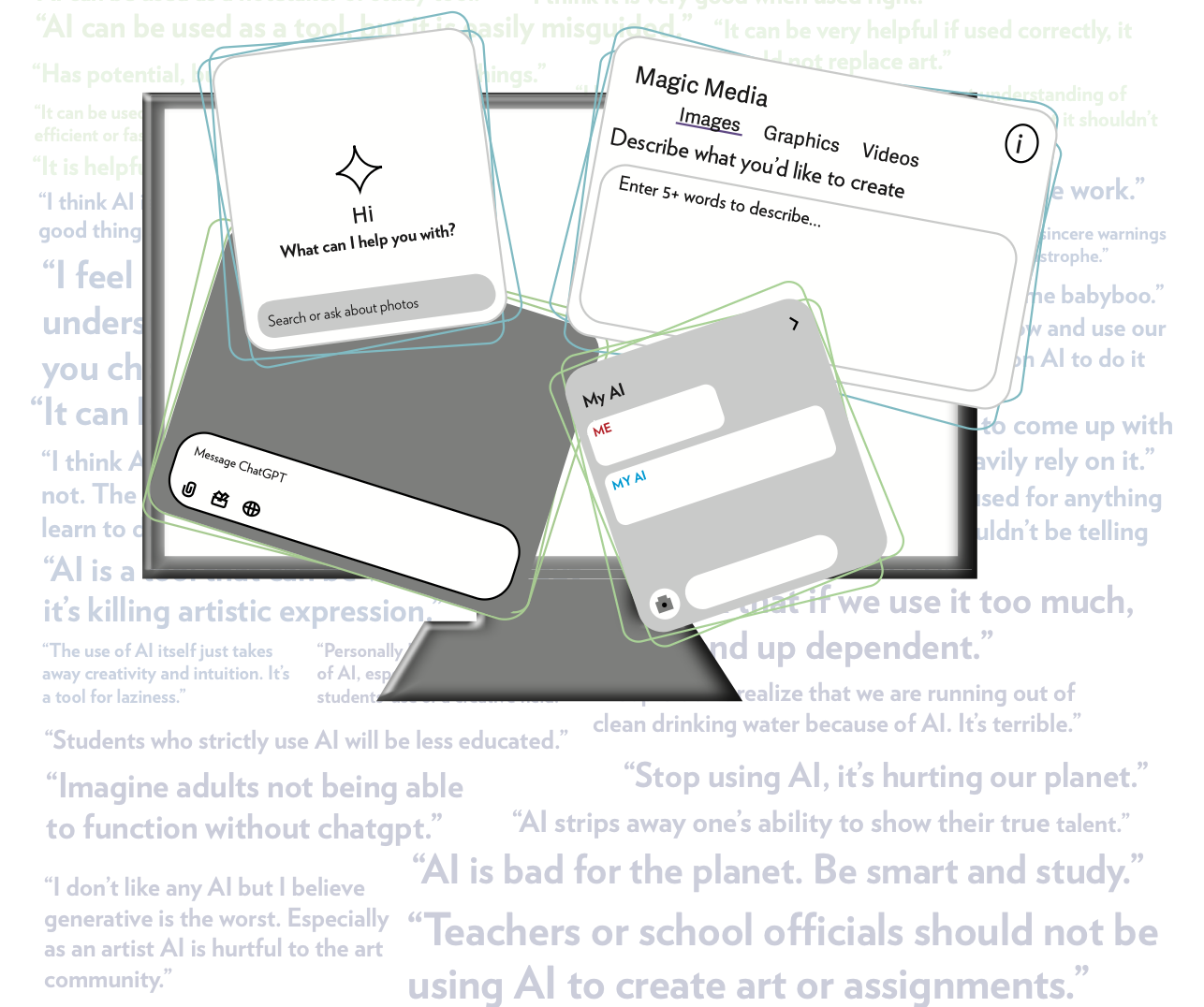
Platforms flooded by robotic videos. Feeds synonymous with artificial photos. Everything from Super Bowl ads to class syllabi seems to consistently refrain back to two letters: AI. It’s of course nothing new: ChatGPT initially released in 2022, Claude a year later. Both remain at the top of mobile app download charts. With AI integrated into everyday technology, education has needed to find a way to adapt. The state of Indiana’s Department of Education has recently announced a collaboration private firms for the purpose of AI literacy. BCSC has a subscription to an AI educational service, SchoolAI. Assistant Director of Education Technology for BCSC, Brenny Kummer, describes her philosophy regarding AI.
“If used with a lot of purpose, it could be really helpful for students,” Kummer said. “It’s a good option. It can remove barriers and maybe help them reach learning goals.”
Junior Lili Martinez agrees, but is cautious of some applications.
“I think that it can be used as a valuable tool, let’s say for translation or if teachers need a good lesson plan, maybe with worksheets that they can’t make on their own,” Martinez said. “But, when it gets to using it for assignments and essays, I think that’s where it gets a bit tricky.”
BCSC Technology Director Nick Williams warns against the potential of letting the negatives become normalized in personal life, despite the potential benefits.
“Maybe some of the negative aspects become a habit in our daily lives, but if you use it as an assistant you kind of have a purpose behind it,” Williams said, “Used intentionally, it’s proven to be a very powerful partner.”
However, not all agree with the tool label, such as freshman Christian Cordova Landero.
“I don’t like generative AI in education because it typically becomes more of a fail-safe rather than a tool, like something that students can fall back on and not have to really work,” Cordova Landero said.
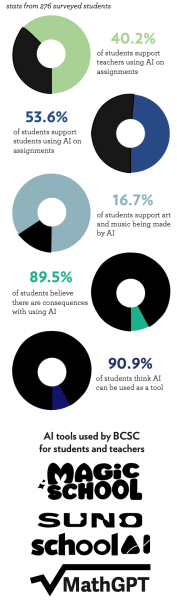
Though AI’s status as a tool is debated, it is becoming integrated into education.
“I think we need to point people to tools that we know are safer,” Kummer said, “And if we’re gonna help students build skills, we need to let them know the good tools from the bad ones.”
Purdue University Professor Daniel Schiff agrees that not all tools are beneficial. Schiff holds a PhD in public policy, and has led several workshops for local and state legislators in an effort to educate them about AI.
“While I think the tools can be pretty cool, and we can come up with some pretty sophisticated use cases or beneficial ones, like assistive services, this is actually the more rare thing,” Schiff said. “Instead, the more common thing I’m afraid we are seeing is skill displacement and cheating.”
BCSC tech provides four separate accounts for student AI usage, with many teachers using additional tools. Junior Finn Cauble has personal experience with this.
“I think it kind of pushes teachers to use a tool that is not necessary and maybe detrimental to students’ learning because AI can very easily mix up details or get things wrong,” Cauble said.
Junior Lou Grafelman also potentially sees issues with the education stagnation that might arise.
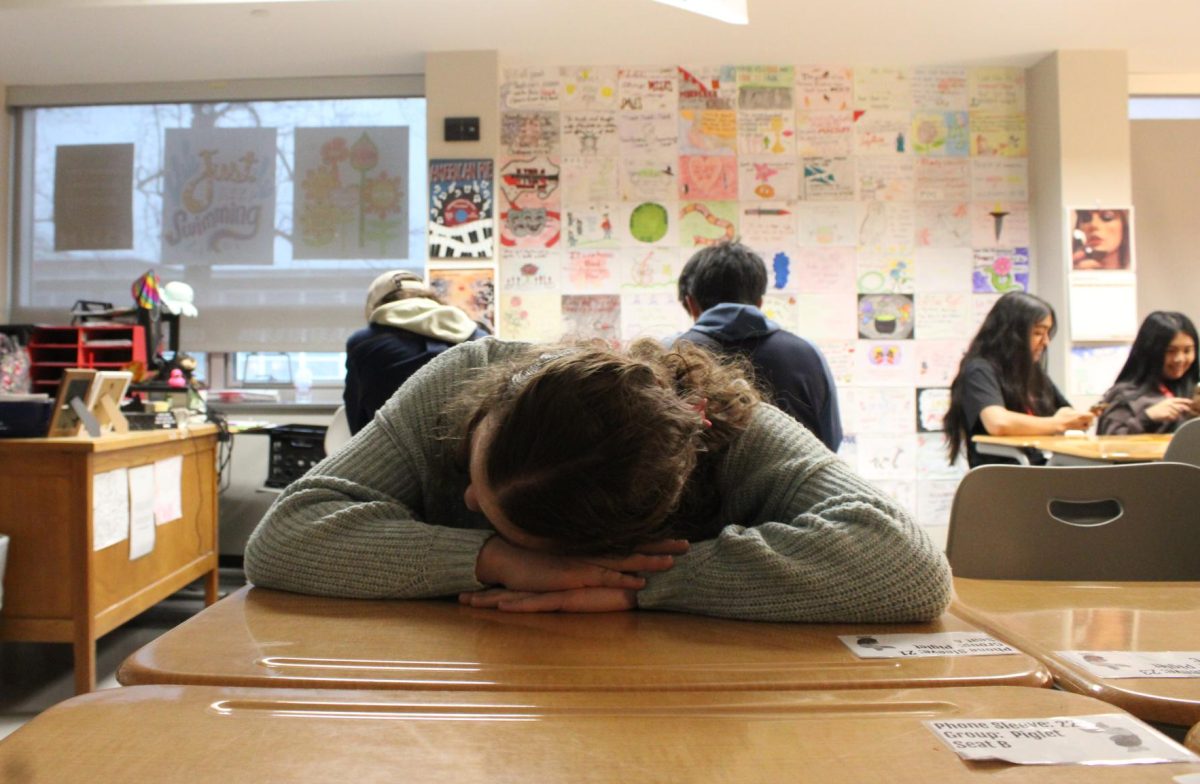
“I think it’s like a cheat way to get things done,” Grafelman said. “I feel like it’d be more enriching to ask kids to draw or write than generate things.”
Junior Wendy Zhong agrees.
“I think AI drastically reduces people’s writing skills,” Zhong said, “Because you can just copy and paste, and I think it’s important for younger people to develop those skills first and then once they know everything, they can get help.”
However, Kummer contends that AI can still be useful, provided one approaches it with the right mindset.
“We need to ask ourselves: what am I going to be doing?” Kummer said, “Am I just trying to get something done really quickly? Or is this elevating a task to a higher level than otherwise maybe I would struggle to do my own?”
According to Schiff, however, students tend not to follow this principle.
This year’s freshmen are now required to pass a computer science class in order to graduate. Despite some ethical concerns regarding AI, some courses are integrating it into curriculum.
“We did a lot with AI in Unit One of our Computer Science Computing Foundations for a Digital Age, kind of getting to know how it works and stuff like that,” Cordova Landero said. “The assignments were kind of centered around how AI responds to different prompts and prompt engineering and how that is developing in the modern age.”
Martinez believes that learning about AI could have some benefits.
“
I think if it’s detecting AI, I think that would be very good, as well if it’s AI literacy and they teach them how to use it right and still use their cognitive thinking skills,” Martinez said. “I think that can be beneficial.”
Schiff thinks that the kind of material courses present on AI have an impact on their effectiveness.
“Generally, my comments about AI literacy programs will be emphasizing the socio-ethical dimensions of them,” Schiff said. “Are people learning what AI is, its strengths and weaknesses, appropriate use and limitations, broader social and ethical consequences, transparency, and so on? Or are they just being taught to use AI technically to be better future workers and consumers?”
In addition to the social and ethical consequences, Moore feels the environmental ones are worth noting.
“Most large-scale AI deployments are housed in data centers, which take a heavy toll on the planet,” Moore said. “They produce electronic waste, which contains mercury and lead. They use water during construction and, once operational, to cool electronic components.”
Grafelman elaborates on the effects of data centers on surrounding communities
“It affects the people that are living around the data centers,” Grafelman said. “When they put up a new data center, it affects their plumbing. They’ll find that their water will stop running or it’ll be tainted with different metals that the data centers output into their water supplies. So they have to buy water instead of just getting it from their tap, and that’s not great for them.”
Moore further explains the amount of water that AI data centers consume.
“Globally, AI-related infrastructure will soon consume six times more water than Denmark,” Moore said. “And so that’s a lot. One ChatGPT prompt consumes 10 times the electricity of a Google search.”
For Cordova Landero, the environmental impacts of AI are too severe for him to consider its use ethical.
“I just don’t think that AI is really beneficial to society, even when used as a tool because of how environmentally dangerous it is and, while recognizing that a lot of things in our daily lives do harm the environment, to such a degree I feel like it’s just too much of a drawback to use it,” Cordova Landero said.
Grafelman takes a similar position.
“I take the extreme stance of just completely against [AI], mostly because there’s no sustainable way to power it,” Grafelman said. “Were there a sustainable way to power it, I can see the benefits in shortening menial labor, getting it to do tasks that we don’t want to, maybe responding to less important emails, stuff like that. There is possibly a benefit were it to be more environmentally friendly and just better for the people it affects.
Cordova Landero also has other ethical concerns surrounding AI use.
“I find that generative AI is unethical because it pulls from a lot of data and a lot of people’s work while not crediting those people when spewing out that work,” Cordova Landero said. “Especially with AI generated images, I would call it stealing, or plagiarizing perhaps more specifically. But it’s plagiarizing these photographs and art pieces from different people and not giving the credit that they deserve. Also, people use it as passing it off as their own or as a creative work. I wouldn’t necessarily call it a creative work because it’s not creating anything. It’s simply putting stuff together.”
Martinez communicates that generating pictures does not qualify as producing art. In fact, artificially generated images are negatively impacting the creative work force.
“AI is trained off of art online,” Martinez said. “It’s trained off of actual artists. So you see AI-generated art all over the world. I think artists are, in fact, losing their jobs, and they’re being stolen from by these AI problems.”
Since generating an image can quickly produce images similar to artistry, as a creator, finding work has become more difficult, according to Cauble.
“I think that the advent of AI has kind of pushed artists to want to put themselves out there more, to differentiate themselves from art that may be created through AI, but I think that it is a detriment in that it can take away creative professions from artists,” Cauble said.
While many find justifications for generating artificial creations, Kummer informs that the final creation should not be entirely made from AI. She explains what artificial intelligence takes away from the human voice.
“AI can be a starting point for something, but whatever it makes should never be your final product,” Kummer said. “You should always be the one to review it and really ask yourself if I’m using this to make something for me or to help me with the project or to help me with the problem, what aspects of my voice am I giving up by having to create that and what do I feel comfortable in doing so?”
Kummer clarifies the importance of keeping the end goal in mind; she understands that there is a balance between using AI and staying true to herself.
“I think the biggest piece in that guidance is focusing on the purpose and then always keeping a human in the loop,” Kummer said.
According to Moore, human relationships are heavily hindered by the usage of AI.
“In education, it can loosen the relationship between a teacher and a student because you’re not really going to your teacher for help,” Moore said, “You’re not asking them, what does this mean, stuff like that. And a lot of people depend on AI to help them a lot. And it kind of gets rid of that human interaction. And that’s definitely what people need.”
Moore believes that when students use AI, teachers have a hard time assisting their students; Zhong believes that it goes the other way as well. When teachers use AI to grade assignments, they aren’t as engaged with their students’ academics.
“The teacher is less involved with your learning,” Zhong said, “It makes it a little bit annoying that you put time and effort into something and then they don’t put the effort in back.”
Martinez explains that if teachers don’t want students to use AI, then they shouldn’t utilize the tool either.
“If a teacher really cracks down on the use of AI in their classroom, I also think that they should stick by that moral,” Martinez said. “It’s just not very fair to have it be one-sided.”
Moore adds that a constant usage of AI can be unhealthy; it is an impersonal relationship, and can cause students to undergo different feelings.
“If I had no friends and I was going to an AI chatbot every day, I wouldn’t care about myself,” Moore said. “I wouldn’t care about my education. I wouldn’t care about my mental health because I’m living in a different reality.”
He discusses the importance of understanding all aspects that AI affects before going to utilize it.
“I feel people who use AI as a resource should definitely know themselves how it impacts everything, how it impacts yourself, the environment, everything,” Moore said.
Grafelman agrees that recognizing the effects of AI is an important step to take before making use of the tool. He wants to ensure that creativity is not diminished by the use of generative ideas.
“Think about the impact it has on your world and think about the impact it has on you,” Grafelman said. “Are you losing skills you used to have? Are you not building that creative muscle in your brain? That is so important to just having an entertaining, interesting and good life.”