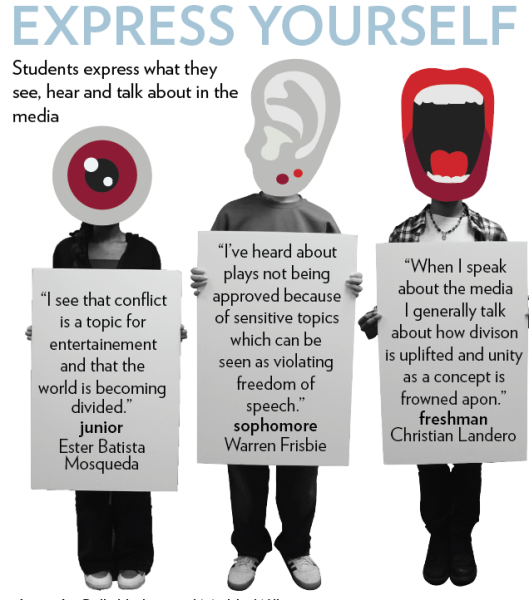
Hundreds of people bundled up in their winter coats march down the street carrying signs and banners. Across town, others quietly peruse library shelves, looking for their next read. Still more wander the sidewalks, stopping to gaze at various sculptures and art installations. Free expression through protest, literature, art and more are all possible thanks to the First Amendment. Ester Batista Mosqueda, secretary of the Art Club, explains how freedom of expression can impact art’s creation.
“I think that a lot of people would choose not to participate in art if they had a risk of being looked down upon or blacklisted for it, or if they put effort into an art and then it was censored,” Batista Mosqueda said.
Art’s value is not simply limited to paintings like many think, but is especially apparent in literature, according to English Department Chair Katie Chaplin.
“We look at books as a way to provide ‘windows, mirrors, and sliding doors’ to students,” Chaplin said. “In other words, we want the characters, themes, and content of books to provide ways every student can see themselves, see others, and vicariously experience the past, present, future, or even imaginary worlds.”
Junior Asher Stidam extends this idea of representation.
“America’s called the Great American Melting Pot,” Stidam said. “It’s because it has all different cultures, all different religions and ways of life that I think would not exist without the First Amendment.”
Also concerned with the possibility of free expression is former North student Tristen Cook. During Cook’s freshman year (2018), he was a part of the organization of a sch
ool-wide walkout in protest of gun violence.
“It basically involved the students who chose to participate walking out, leaving their class and gathering around the flagpoles in the front,” Cook said. “And then the group that led it, me and I think it was like six or seven other people, we all wrote down a little thing and then we read off the names of some students that had lost their lives in the Parkland shooting, which just happened recently at the time.”
However, these moments are not limited to the past, as Stidam demonstrates. Stidam is the president of a local youth board that demonstrated their First Amendment rights first-hand as recently as February of this year.
“We went to the statehouse with some other people and had an assembly there that advocated for an increase in tobacco tax, where the new tax’s extra money would go directly into funding tobacco prevention programs,” Stidam said. “And it passed.”
Marsh signifies the weight of the term “freedom.”
“[Freedoms] are those opportunities that we have in this country to act to behave or speak out without worry about our government infringing upon, stopping, arresting, or sending us to jail for those actions and behaviors,” Marsh said.
However, Marsh cautions against the idea that the First Amendment is unlimited.
“The big thing we need to keep in mind is a lot of times we assume that our First Amendment protects us from anything, and that’s not the case,” Marsh said. “The First Amendment protects you from actions of the government.”
Despite this, Cook believes that these freedoms are what ensure change.
“If we didn’t protest, then the government would do whatever they want,” Cook said. “If we didn’t let our voices be heard, then change wouldn’t be made.”
In addition to helping find his personal voice, the walkout helped find the wider community’s voice, according to Cook.
“That was the first time I had ever really partaken and participated in something like that,” Cook said. “And, so I just learned the impact that it had on myself. I was talking about it with people afterwards, and it had an impact on the community as well.”
Olivia Mapes believes that protesting isn’t the only way to use the First Amendment to tie a community together. Mapes is the editor-in-chief of Purdue University’s The Exponent, an independent student newspaper.
“It doesn’t have to be groundbreaking news,” Mapes said. “I think, to me, journalism is an integral part of a community. It keeps people together.”
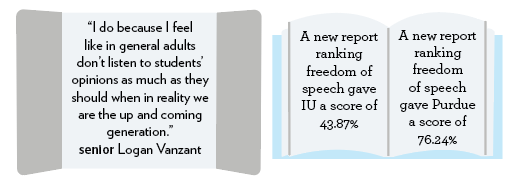
According to a Letter From the Editors published by Indiana University’s student publication, the Indiana Daily Student (abbreviated as the IDS), on Oct. 14, IU ordered the IDS to stop printing news in special editions, which were the only issues it was allowed to print. When the Director of Student Media refused to enforce this, he was fired. The IDS was banned from printing any physical copies of their newspaper later that evening. On Oct. 30, it was announced that Indiana University had decided to “reverse course,” and the Indiana Daily Student was allowed to resume printing, so long as they “remain true to budgetary parameters.” The Exponent printed a “solidarity issue” in support of the IDS and distributed in Bloomington. Their photo editor Charlie Stapleton shares how he felt when he first heard the initial news.
“My initial reaction was just like a mix of just frustration and, ‘I’m not surprised,’” Stapleton said. “A lot of Indiana universities have been having issues like free speech stuff and kind of targeting their student newspapers.”
Director of the Indiana High School Press Association Ryan Gunterman vividly remembers the raw emotions he felt upon learning of the situation.
“It was pure anger,” Gunterman said. “I mean, pure rage. I was trying to go to bed and failed miserably that Tuesday night. Within the 24 hours when they announced that they’re getting rid of the print edition that was supposed to come out in two days, [I] was just [in] disbelief because I couldn’t believe that they were so nonchalant with their PR strategy, and just unaware how that would affect people and how people would react to that. Doing both of those things within a very short period of time is just rage-inducing.”
Batista Mosqueda felt the situation of censorship on a personal level. 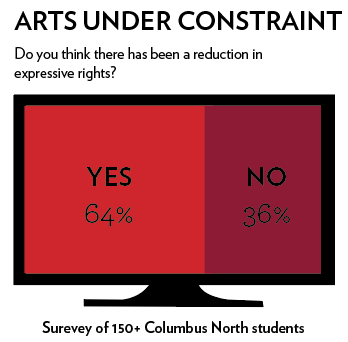
“[The issue of censorship] honestly speaks to me as a person who is from Cuba, a communist country,” Batista Mosqueda said. “So, I feel strongly about that.”
An example of this freedom lacking in other nations can be found in our own libraries, according to Dowling.
“Our libraries generally try to be a free, democratic space where you can come and choose what you want to read or what you don’t want to read,” Dowling said.
Without such freedom, there would be dire consequences, according to Dowling.
“I think one of the dangers [in over-control] would be that we would have a lot of high-interest texts removed possibly or a lack of diversity in our collection,” Dowling said. “One of the major problems is that books are very subjective and books in a library are optional. And so, you know, we want to make it as free and open as possible without restricting, everyone.”
Mapes believes that this freedom, or lack thereof, affects numerous people today.
“[The First Amendment] lets people be able to speak their minds and not be restricted,” Mapes said. “I think currently there’s a lot of people who are scared of talking about things [right now].”
Gunterman explains how this fundamental was potentially attacked with the IDS.
“People don’t always associate censorship with schools necessarily, but most schools are public entities,” Gunterman said. “They are government-funded entities. So the fact that a school would censor students for speech, for something that is outlined in the First Amendment, it’s government censorship. It’s public students being prevented from practicing a First Amendment right by the government. And that is just straight up censorship.”
However, IU aren’t the only ones to have felt this impact recently, according to The Exponent adviser Kyle Charters.
“It echoed pretty strongly with what we had faced here a few months earlier over the summer with Purdue deciding that it was not going to facilitate distribution of our paper on campus,” Charters said. “Now, because we’re completely independent of the university, it has not completely ground our print to a halt. We still print. We’re just diminished, I think, in our print drop-off locations by about 30 percent.”
Charters boils down his newspaper’s fight to a single idea.
“When you look at the situations that have happened over this year, both with [The Purdue Exponent] and with the IDS, I think any attempt to curtail distribution of a newspaper in a community is a form of censorship or violation of the First Amendment,” Charters said.
However, Stapleton believes that these situations are far from isolated incidents.
“I think it sets a bit of a precedent for other universities that they can do what they can to try and silence journalism,” Stapleton said. “On a lower level, a more collective level, people care and people will do whatever they are able to support student journalism.”
Gunterman believes that those who control the papers are becoming more and more dangerous to put faith into with each passing year.
“It’s becoming increasingly difficult to trust the people in authority, specifically at IU,” Gunterman said. “Last November, I was in a meeting that involved the dean and the undergraduate dean of the media school, and they just straight up told us that this would not happen. Here we are not even 365 days later, and they’ve done all the things that they said they wouldn’t do. Straight up just right to our faces. It just shows that the people in authority are just not going to give you a free pass to publish the truth.”
Stapleton believes much of that deceit can be owed to a simple desire for profits.
“Universities, at the end of the day, are basically a business, and they will do what they can to make a profit where they can,” Stapleton said. “At the end of the day, that typically does affect the students, and I think that’s important for everyone to be aware about. They should know what’s going on.”
Gunterman, also Executive Director of the Indiana High School Press Association, further believes that the guise of financial reorganizing gives university leadership dangerous levels of control.
“Here at Franklin College, we pay for everything, and there is not an expectation that we control the students because of that,” Gunterman said. “At IU, the expectation is, since they’re now paying for things, they’re going to control the things. And unfortunately, controlling the things suppresses student speech, student press, and First Amendment freedoms.”
Not only do IU officials have unprecedented levels of power, they are also removing voices of dissent, according to Gunterman.
“We have a president at IU who has received a no confidence vote from the faculty, and university presidents don’t survive that,” Gunterman said. “Well, she did. And not only that, she, the governor, replaced the few voices that were dissenting on the board of trustees and replaced them with yes-people who will just sign off on anything that she wants to do. So you can’t take for granted that people doing the wrong thing will face appropriate consequences.”
Stapleton explains how he and members of his generation hardly know anything but the status quo that Guneterman described.
“If I’m being honest, I don’t know what real freedom on a college campus would look like, because there’s never been any examples of that,” Stapleton said.
According to Gunterman, however, students tend to embrace freedom.
“Students don’t learn censorship,” Gunterman said. “If anything, it makes them upset. If anything, it motivates them. It empowers them. It’s kind of the ‘how dare you’ mentality. There is nothing more motivating to a young person than old people and people in authority telling them ‘you can’t do this’ or ‘you shouldn’t do this.’”
However, student action doesn’t have to be as complicated as staff removals, according to Dowling.
“It’s so important [to stay informed] because there’s so much misinformation,” Dowling said. “And so, you know, sometimes things are being said that aren’t necessarily true. So staying informed about what’s really happening is very important.”
That process of education can begin far closer than one might expect.
“[Library books are] here for you guys to use,” Dowling said. “I think it’s important to care about what’s in your library, what you have available to you, that you’re represented on the library shelves. It’s important to know if things are being removed and why people want to remove them, to stay informed.”
Oftentimes, there might be a more personal reason to stay informed, according to Gunterman.
“It can happen to you,” Gunterman said. “Just because you have more freedom than say the IDS does right now, it doesn’t mean that’s always going to be that way. At some point, it’s going to be you in the crosshairs and the one who’s being targeted whether it be professionally or personally. And if that is the moment you decide to care, then it’s usually too late.”
Even in the midst of attempts to silence, young people will always strive to find ways to make an impact, according to Cook. Further, from organizing protests to defending student newspapers, Cook feels students will never stop using their voice that he first developed so long ago to find the courage that Gunterman finds so crucial, the understanding of freedom that Marsh describes, and the desire for diversity that Chaplin feels is so necessary.
“It’s so impactful,” Cook said. “It’s so meaningful, not only individually, but when you rally as a community and let your voice be heard, let your collective voice be heard, it makes an impact. It truly, truly, truly does.”
Cook continues.
“It’s important to use your voice,” Cook said. “We only have one lifetime and we do have to stand up for what we believe in.”