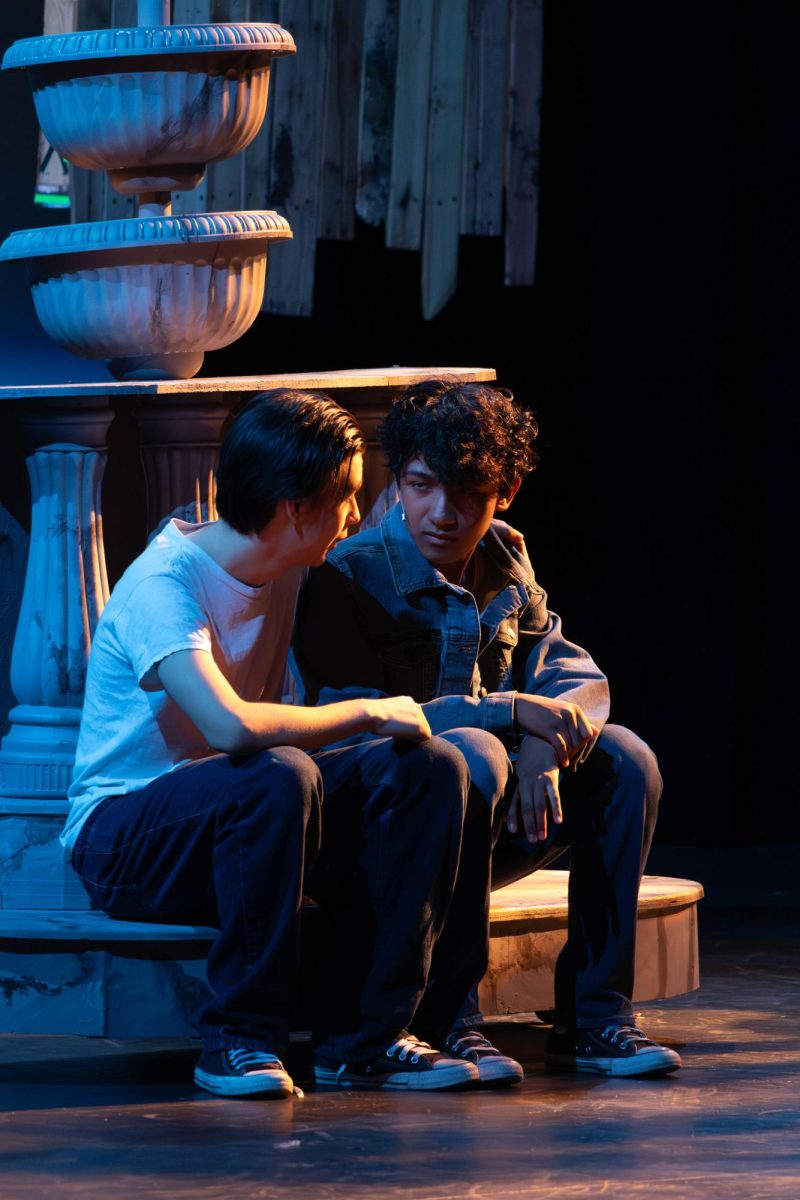
Despite being enemies, the Greasers and Socs in The Outsiders do share one thing in common: a big, golden ball in the sky. Thespians performed the Outsiders play this fall, the director Justine Lykins deciding to make some unconventional decisions while casting. In this play, she decided to double-cast, along with cast underclassmen as leads. Both junior Lou Grafelman and freshman Isaac Zigler were chosen to play lead Ponyboy Curtis. The casting decisions differed from the norm, so Gra
felman and Zigler gave their opinions on double casting,
Grafelman started their theater journey at the beginning of high school, joining the fall play during their freshman year.
“I have been doing theater since my freshman year,” Grafelman said, “My first big role was my freshman year play. I didn’t play a lead role, but a main supporting role of Mr. Body in Clue. Sophomore year, I played the leading man in the studio room show, Chris Keller, and again in the play, sophomore year, I played the lead man, Mr. Reeder, in Radium Girls.”
Zigler started a bit earlier than Grafelman, but had a similar experience in their earlier years of theater.
“This is my first big role,” Zigler said. “I was an elf in Elf, had a small part in The Wizard of Oz, and was young Dimitri in Anastasia. But, this is actually my first speaking role.”
Both played Ponyboy Curtis due to the directors decision to double-cast the play. This decision led to some difficulties, but also did some good for the overall production of the play.
“[Some negatives are] when it comes to our choreographed fights in the show. It takes longer to learn things since we learn them together,” Grafelman said. “It’s also rough to have to swap out some people and reteach it. For costumes, having double the amount is also rough [on our staff]. Another thing is only getting to do two shows instead of three since we’re splitting it between the casts.”
Zigler had similar issues with double-casting as Grafelman.
“I see the benefits and I see the downsides [to double casting,]” Zigler said. “One of the downsides is four shows. I wouldn’t say Thursday is the optimal day for a show.”
However, there are benefits to double-casting that Grafelman and Zigler share a view on.
“I think when you do [double casting] right, it’s good,” Grafelman said. “It’s hard to do it right, but it’s good in theory. Having a built-in understudy in case anyone gets sick, opening up so many roles for people, and lessening the rehearsal load for most people [is really beneficial]. It cuts it down to two to three a week instead of every day.”
Zigler went more in-depth about how having more roles is beneficial to the play and the theater department itself.
“You have more talent in it. There are a lot of roles that could have been given to people, and with the double-casts it gives people the opportunity to shine in their own ways. It makes it a lot better for people to get roles in comparison to one cast.”
While Grafelman was overall more positive towards double casting, Zigler was more critical.
“I wouldn’t say double casting is my favorite thing in the world. It can be very stressful because you get less practice time, and you don’t have all the days you want. It has its goods, it has its bads, but overall I wouldn’t prefer it.”
The director also decided to cast underclassmen as leads, including Zigler. This, while previously done before with differing reactions, seems to be becoming a new norm in theater as time goes on.
“A few years ago, this would have been practically unheard of,” Grafelman said. “A Freshman got cast as a lead and it was groundbreaking. People were furious, but I feel like more recently they’ve been getting bigger and bigger roles. It’s, of course, still unusual for some people, but it’s becoming somewhat of a new normal. Casting where the director sees the potential and not solely on seniority.”
Zigler shares a similar sentiment.
“If this is a continual pattern, I think lower and upperclassmen can have equal opportunities,” Zigler said. I stand by the fact that upperclassmen should have more opportunities since it’s their last few years, but I think it should be less of a factor. It should be more about looking for talent, looking for people who fill the roles best. I still think there should still be seniority, but not the main reason.”
Giving underclassmen more opportunities also helps with having a connected theater department. When Grafelman first joined, it was nerve-wracking.
“It was a really rough first day,” Grafelman said. “Beyond that, it’s been just wonderful. I got into it because my friends had siblings in theater. I never had a direct connection with theater. My first show, my first readthrough, I didn’t know anyone, and that was rough, but after a week, it was fine. They were so welcoming, and I took those connections with me to other shows, and I got connections from show choir.”
Zigler shares his thoughts on joining the theater initially and how he felt.
““I don’t think it’s hard to get involved in the group,” Zigler said. “It can be very intimidating early on, a lot of really talented people who shine, and you think, ‘how am I ever going to get up there? How am I ever going to climb to that rank?’ But they’re really nice people who will include you.”
Zigler also had a experience of stress and nervousness early on in his theater.
“Early on, when I was in middle school, it was very stressful,” Zigler said,
“Especially during Anastasia. In the early days of it, it was some of the most stressful first days I’ve had.” However he has found a place in theater over time.
“Now I’ve been here a long time and I know these people. I feel more comfortable, and included, I feel like I’m part of it.”