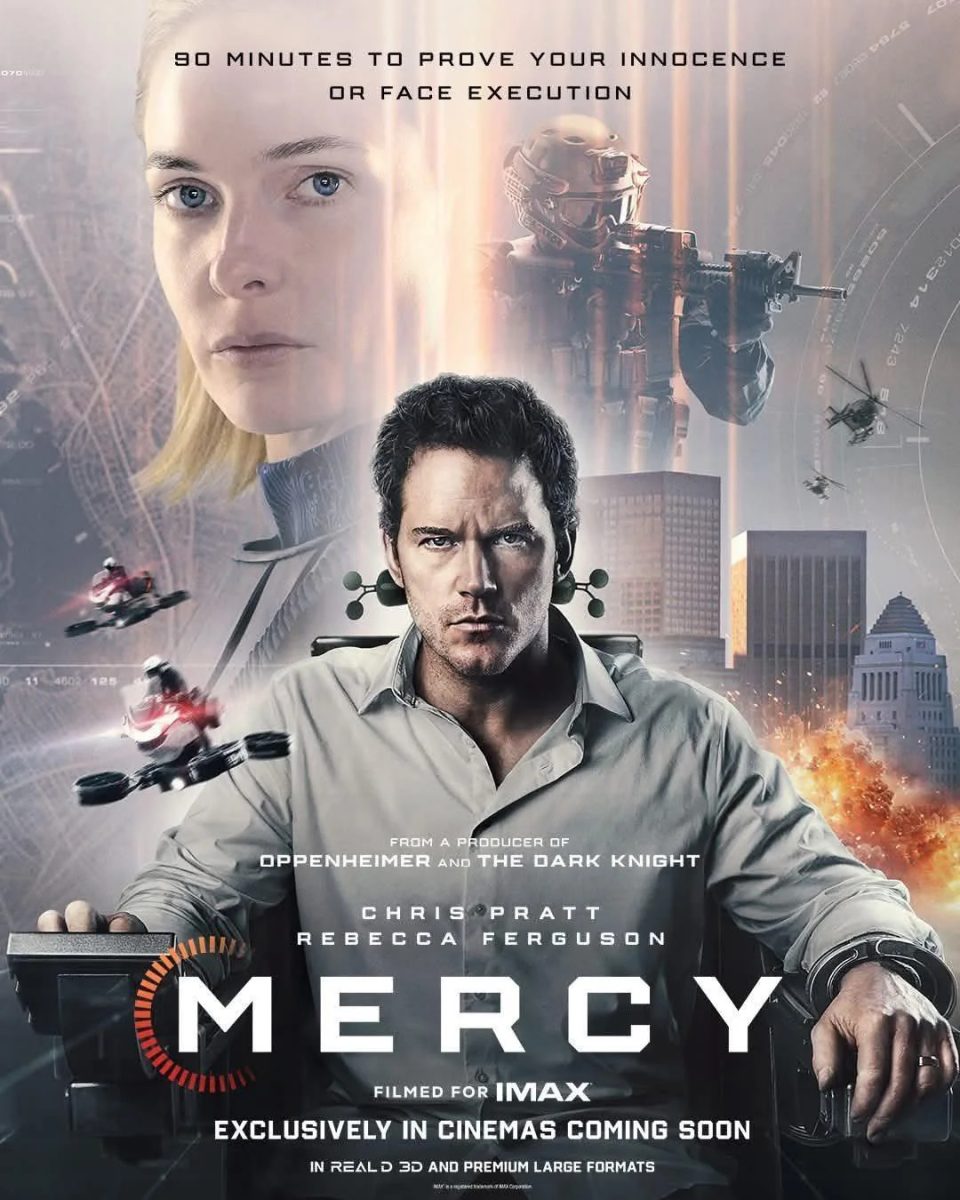
I knew when I walked into “Mercy” that it wasn’t going to be incredible. I had seen the countless bad reviews and criticisms of it online. Although the filmmakers chose an interesting premise, the final product was generic and predictable.
The general idea of the movie showed some promise. It was set in a futuristic, dystopian version of Los Angeles where criminals were forced to live in “red zones,” all online activity was monitored by the government, and some crimes that were deemed serious enough and had a very likely suspect were given Mercy Trials: a court proceeding where the defendant had 90 minutes to prove their innocence to an AI judge or face the death penalty. Chris Raven, a detective with the L.A.P.D. who was a proponent of the Mercy program, is accused of his wife’s murder and enters one such trial. These elements provided ample opportunities for meaningful exploration of timely topics, none of which the film took. Instead, it chose to emphasize action scenes and the mystery of who really murdered Raven’s wife.
One positive thing I will say about “Mercy” is that it managed to occupy my brain for a little over an hour. But when the lights in the theater came back on, I was left feeling a bit let down. Despite the dystopian setting, there is very little discussion about it. I was hoping for some more hints at the absurdity of allowing an Artificial Intelligence to decide whether someone lives or dies, especially when the entire plot of the movie revolves around how that very same program made a huge mistake. At the very least, I wanted a few more characters to feel disturbed by the fact that they are living in a surveillance state or that there were effectively government-mandated slums in their city. What I got instead were run-of-the-mill investigation scenes, police chases, explosions, and more police chases.
While the movie made for decent entertainment, the decision to brush over some of the more chilling elements of the premise was painfully noticeable, especially given how prevalent concerns about AI and government surveillance have been recently. Making it more of a stereotypical action movie was definitely a safe option, but it feels like the filmmakers passed up a golden opportunity to make their work stand out. Ultimately, that decision makes “Mercy” both disappointing and completely forgettable.
Plot holes: if Mercy has access to all the evidence that Raven uses to prove his innocence, how did it not figure it out earlier?